


Five Years After Pipeline P00547
Five years ago, I was supposed to be packing for a long-awaited road trip through the Pacific Northwest with my best friend. Instead, I got the call telling me that an oil spill had occurred near Huntington Beach, and that I was to pack my spill gear and head in the opposite direction to support the response that became known as Pipeline P00547.

The incident would become one of California's largest oil spill responses in years, with the Oiled Wildlife Care Network (OWCN) mobilizing hundreds of responders across dozens of agencies and organizations. For me it was also my first major disaster response, offering a crash course in mass communications during sensitive environmental emergencies.

Five years later, P00547 offers an opportunity to look back at what the response required, what worked, and how lessons from those weeks in Southern California continue to inform OWCN responses today. In addition to my own perspective, we’ll be speaking with several experts who were deeply involved in the response about what they learned and what it’s like to look back.
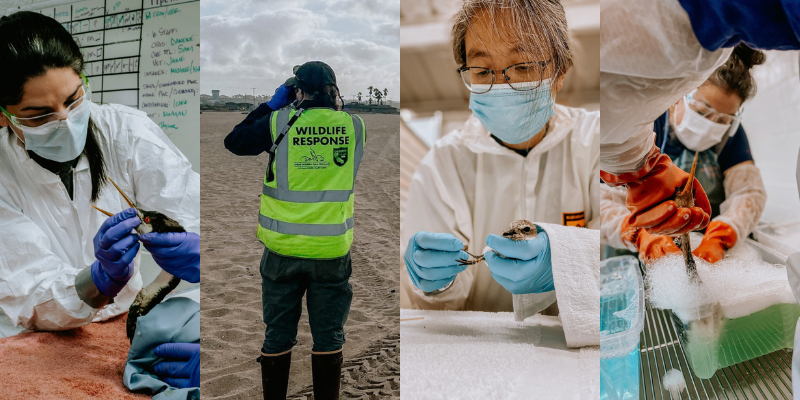
The strength of the Network
At the time, Julie Yamamoto was serving as deputy administrator for CDFW-OSPR. Looking back, she remembers the sheer size of the operational area, particularly when fisheries closure boundaries were included, as one of the factors that stretched personnel and resources.

The size and duration of the incident also required an unprecedented Liaison operation to support outreach and communication with elected officials, state and local agencies, NGOs, and other interested groups. “Exceptional coordination among all the players and interested parties was required,” Julie said.
The response also demonstrated the value of having wildlife response infrastructure already in place, including fixed care facilities that were ready to activate and support OWCN operations. That ability to draw on established partnerships became particularly important when word came in that federally threatened western snowy plovers had been affected by the spill.

Point Blue Conservation Science Biologist Carleton Eyster brought extensive experience with snowy plover behavior and capture. Capturing an individual oiled bird within a flock is difficult, and compromised birds can behave differently than healthy birds. Carleton's previous experience capturing plovers with leg injuries helped inform his approach to the oiled birds during P00547.

“My intimate familiarity with snowy plover behavior certainly helped our team's ability to capture several oiled birds,” Carleton said. But he credits the established response structure with making it possible to put that expertise to use. “It was the well-established preparedness and communication networks that facilitated my involvement.”
Carleton also shared his techniques with OWCN field responders, adding to the expertise that would remain within the Network after the response ended. On his final day onsite, a team of staff and trained volunteers successfully captured one of the remaining oiled plovers while it roosted among a flock of non-oiled birds.
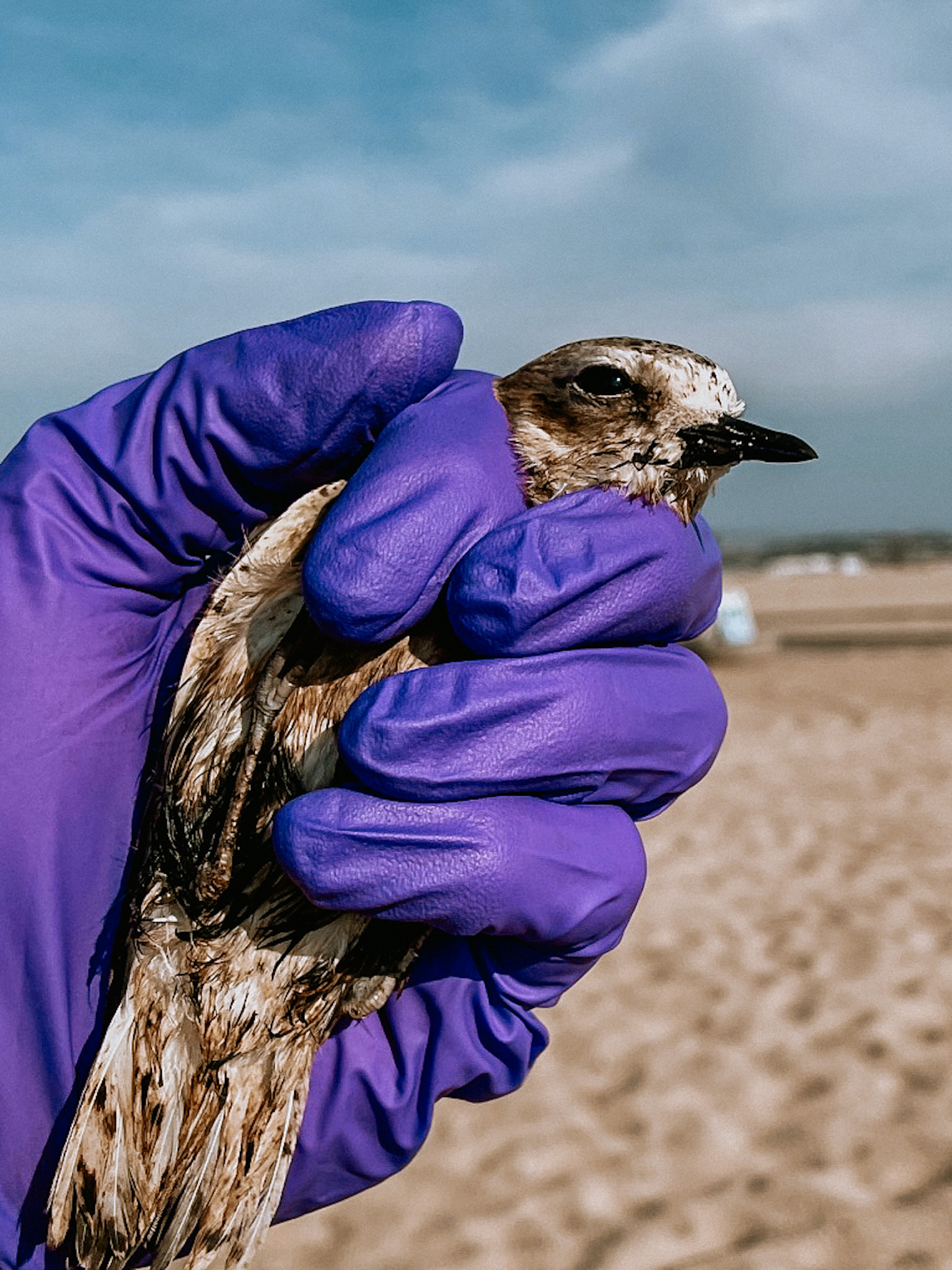
Once captured, the plovers moved through the field stabilization phase of the OWCN response at Wetlands & Wildlife Care Center, followed by intake and processing at the Los Angeles Oiled Bird Care and Education Center, where another group of responders took over their care.
Learning in real time
I had taken over as OWCN's Public Information Officer in 2018, but until P00547 in 2021 I had never been deployed to a major spill. There is only so much training that could have prepared me for the pace of the real thing.

I was learning how to operate within the Federal Emergency Management Agency’s Incident Command System while simultaneously doing my job: adapting as information changed, addressing the needs of different audiences, and communicating quickly without getting ahead of what we actually knew.
CDFW-OSPR Public Information Officer Eric Laughlin was leading public information efforts amid intense media and public attention on this high-profile spill. “The incident reinforced the importance of timely, real-time updates on wildlife impacts and response efforts,” Eric said. That included quickly launching a website and closely monitoring social media to clarify rumors and misinformation.

Eric and I had worked together before, but P00547 helped establish a communications approach on which we continue to build. While he focused on the press, high-level communications, and the broader incident, I concentrated on wildlife, gathering information and visuals from the field and care facilities, and sharing that work with the public.

For me, it was also an opportunity to understand where wildlife communications fit within a large incident response and where we could continue to improve.
Applying what we learned
For OWCN Wildlife Rehabilitator Sam Christie, one of the defining challenges of P00547 was responding during the COVID-19 pandemic. Spill response protocols had to account not only for the health and safety of wildlife, but also for the possibility of disease transmission among responders.

Each workday began with symptom screening and outdoor, distanced safety briefings. Responders wore masks and incorporated additional disinfection protocols throughout the facility. Those measures allowed wildlife operations to continue without COVID shutting down the response.
Among the animals cared for were seven snowy plovers, each weighing approximately 35 grams and particularly vulnerable to hypothermia and other effects of oiling. “After expert supportive care, washing, and careful monitoring, all seven survived to return to the wild for a chance to contribute to the recovery of their species,” Sam said.

The experience caring for the plovers also identified opportunities to improve the versatility of outdoor enclosures at the Los Angeles Oiled Bird Care and Education Center. Those improvements were used during the recent 400 Eastern Avenue response to care for 11 Black-necked Stilt chicks.
“Each response is full of lessons – things that worked well, and things that could be improved,” Sam said. “The responders and the wildlife of the P00547 response absolutely made our Network stronger.”
Five years later
P00547 demonstrated what OWCN was built to do: bring together trained responders, facilities, equipment, established partnerships, and specialized expertise to provide the best achievable capture and care for oil-affected wildlife during a large and complex incident.

It also gave us opportunities to enhance existing protocols to further advance the field of oiled wildlife response. Lessons from the response informed facility improvements, strengthened working relationships, expanded field expertise, and helped shape how we communicate during major incidents. Some of those changes can be seen directly in responses happening today.
Looking back, both Eric and Julie point to the people behind the response as one of its lasting impressions. “I always think of all the responders and their passion and ability to thrive under pressure to protect resources,” Eric said, noting that large responses like P00547 demonstrate the effectiveness and cohesiveness of the partnership between CDFW-OSPR and OWCN.

For Julie, it is the commitment, expertise, and teamwork sustained over weeks of demanding response work that remains particularly memorable. “These larger responses always, after the dust settles, leave me with a sense of gratitude and awe for the people that make it all happen, day after exhausting day,” she said.
For me, P00547 was the response where years of training became practical experience. It helped define how I approach my role today, but it also sparked an excitement for emergency response work that has stayed with me ever since. I came away wanting to keep learning, keep improving, and be better prepared for the next response.
That same drive is built into the OWCN. Every response tests what we've built, shows us what works, identifies where we can improve, and adds new experience to the collective expertise of the Network.
Five years after P00547, we're still putting those lessons to work.